
Why Are Researchers Studying Hyperbaric Oxygen Therapy for Certain Serious Eye Conditions?
Vision depends on one of the most metabolically active tissues in the human body. Although the eyes are relatively small, structures such as the retina and optic nerve require a continuous supply of oxygen to convert light into nerve signals that the brain can interpret. Even brief interruptions in oxygen delivery can affect cellular function, and prolonged oxygen deprivation may result in permanent visual impairment.
Many serious eye conditions develop because blood flow to delicate ocular tissues becomes compromised. In these situations, conventional treatments may not always restore sufficient oxygen to injured cells before irreversible damage occurs. This challenge has led researchers to investigate therapies that improve tissue oxygenation through different physiological mechanisms.
One area receiving growing scientific attention is Hyperbaric Oxygen Therapy (HBOT). Although HBOT is not considered routine treatment for most ophthalmic disorders, published research over the past two decades suggests it may have an important supportive role in selected vision-threatening conditions. Understanding this growing interest begins with understanding why healthy vision depends so heavily on oxygen.
Why the Eye Depends on a Constant Oxygen Supply
The eye functions continuously, even during periods of rest. Photoreceptor cells within the retina constantly convert incoming light into electrical signals, while retinal nerve cells rapidly process visual information before transmitting it to the brain through the optic nerve. These highly specialized tissues consume oxygen at one of the highest rates anywhere in the body.
Unlike muscles or skin, retinal tissue has very limited tolerance for oxygen deprivation. The retina cannot store meaningful oxygen reserves, making it dependent on uninterrupted blood flow through an intricate network of tiny retinal and choroidal blood vessels. Even short periods of reduced circulation may disrupt cellular metabolism and impair normal visual function.
Because these structures are exceptionally sensitive to changes in oxygen availability, ophthalmologists often consider restoring tissue oxygenation an important objective when managing certain acute and chronic eye diseases.
How Reduced Oxygen Can Threaten Vision
Many serious ophthalmic disorders share a common biological feature: inadequate oxygen delivery to ocular tissue.
For example, retinal artery occlusion suddenly blocks the blood supply to the retina, creating an ophthalmic emergency in which retinal cells rapidly become oxygen-deprived. Without prompt restoration of oxygen, permanent vision loss may occur within a relatively short period.
Other conditions develop more gradually. Retinal vein occlusion may increase pressure within retinal blood vessels, contributing to fluid accumulation and cystoid macular edema that interferes with central vision. Surgical complications, radiation injury, severe infections, and persistent corneal disease may also impair circulation, slowing normal tissue repair and prolonging inflammation.
Although these disorders differ in their underlying causes, they often share a similar physiological consequence: tissues receive less oxygen than they require to maintain normal cellular activity and healing.
Recognizing this common pathway has encouraged researchers to explore whether improving tissue oxygenation might complement conventional ophthalmic treatments in carefully selected patients.
Why Researchers Began Studying Hyperbaric Oxygen Therapy
Hyperbaric Oxygen Therapy attracted attention in ophthalmology because it addresses one of the central biological problems present in many vision-threatening conditions: tissue hypoxia.
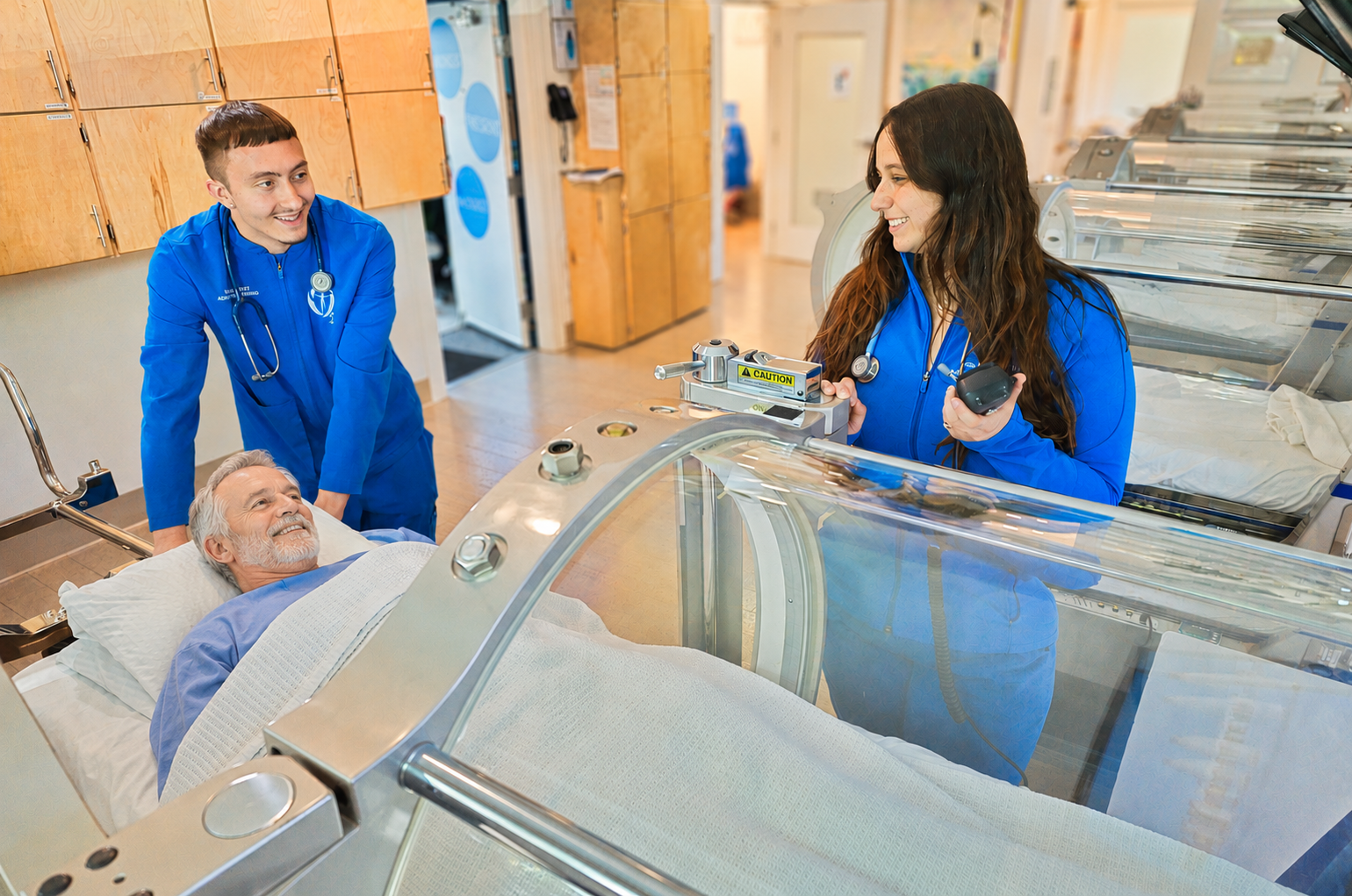
During HBOT, patients breathe 100 percent medical-grade oxygen inside a pressurized chamber. Increased atmospheric pressure allows substantially greater amounts of oxygen to dissolve directly into blood plasma, enabling oxygen to reach tissues beyond its normal transport through red blood cells.
Researchers proposed that this increase in dissolved oxygen could temporarily support ocular tissues experiencing reduced circulation while the underlying condition is being treated. Laboratory investigations have also suggested that improved oxygen availability may influence several physiological processes involved in tissue recovery, including cellular metabolism, collagen synthesis, inflammatory regulation, and angiogenesis—the formation of new blood vessels that support long-term tissue repair.
Rather than replacing conventional ophthalmic care, HBOT has been investigated as an adjunctive therapy designed to improve the biological environment in which healing occurs.
What the Ophthalmology Research Shows
A comprehensive review published in Survey of Ophthalmology evaluated the available scientific evidence regarding Hyperbaric Oxygen Therapy across a wide range of eye diseases. Rather than focusing on a single disorder, the review examined both established clinical experience and emerging research involving several conditions associated with tissue hypoxia and impaired ocular healing.
The authors identified encouraging evidence supporting HBOT in selected situations, including central retinal artery occlusion, cystoid macular edema secondary to retinal vein occlusion, radiation-related scleral necrosis, nonhealing corneal edema, anterior segment ischemia, and orbital rhino-cerebral mucormycosis. Across these conditions, researchers consistently observed that improved tissue oxygenation may help preserve cellular function or support healing when combined with appropriate ophthalmic management.
Importantly, the review also emphasized that evidence varies considerably between conditions. Some applications are supported by stronger clinical experience than others, while several remain investigational and require additional prospective studies before broader recommendations can be established.
Rather than presenting HBOT as a universal treatment for eye disease, the review highlights its potential role in carefully selected clinical situations where oxygen deprivation contributes significantly to tissue injury and visual decline.
Why Early Treatment May Influence Outcomes
One of the most consistent observations throughout ophthalmic research is that timing often determines the success of treatment. Unlike many other tissues in the body, the retina has a very limited ability to tolerate prolonged oxygen deprivation. Once retinal cells lose their oxygen supply, irreversible cellular damage may occur within a relatively short period.
For conditions such as central retinal artery occlusion, researchers have reported that earlier intervention is associated with a greater opportunity to preserve retinal function before permanent injury develops. This is why ophthalmologists consider retinal vascular occlusions true medical emergencies that require immediate evaluation.
The ophthalmology review also emphasizes that Hyperbaric Oxygen Therapy is most effective when integrated into the overall treatment strategy as early as clinically appropriate. HBOT is not intended to replace established ophthalmic interventions but may serve as supportive therapy while physicians address the underlying cause of reduced blood flow or tissue injury.
This emphasis on timely treatment highlights an important principle of ocular medicine: preserving viable tissue is often easier than restoring tissue that has already undergone irreversible damage.
Current Clinical Perspective on Hyperbaric Oxygen Therapy in Ophthalmology
Although scientific interest continues to grow, Hyperbaric Oxygen Therapy occupies a carefully defined position within modern ophthalmology.
The Undersea and Hyperbaric Medical Society (UHMS) recognizes HBOT as an established treatment for several approved medical conditions involving tissue hypoxia, decompression illness, radiation injury, carbon monoxide poisoning, and difficult-to-heal wounds. However, most ophthalmic applications remain off-label, meaning they are supported by varying levels of clinical evidence rather than broad regulatory approval.
This distinction is important because different eye diseases have different biological mechanisms. Some conditions involve sudden interruption of blood flow, while others develop through chronic inflammation, impaired healing, radiation damage, or severe infection. As a result, the potential role of HBOT differs depending on the underlying diagnosis, disease severity, and timing of treatment.
The ophthalmology review concludes that current evidence is strongest for selected ischemic and difficult-to-heal ocular conditions while encouraging additional prospective clinical trials to better define treatment protocols and long-term outcomes. This balanced approach reflects the way evidence-based medicine evolves: through careful investigation, clinical observation, and ongoing research rather than isolated case reports alone.
To better understand the current scientific evidence, explore the following clinical research publications and case studies investigating Hyperbaric Oxygen Therapy in ophthalmology.
Case study 1: https://www.sciencedirect.com/science/article/abs/pii/S0039625707003013
Case study 2: https://pmc.ncbi.nlm.nih.gov/articles/PMC11009234/
Case study 3: https://pmc.ncbi.nlm.nih.gov/articles/PMC10779579/
What These Findings Mean for Patients
The growing body of ophthalmic research does not suggest that Hyperbaric Oxygen Therapy should be used for every eye disease. Instead, it demonstrates that understanding the biological cause of vision loss is essential when determining whether additional therapies may be appropriate.
Patients experiencing sudden vision changes should seek immediate evaluation by an ophthalmologist, as early diagnosis remains the most important factor influencing treatment decisions. When tissue hypoxia, radiation injury, or impaired wound healing contributes to the disease process, physicians may consider whether Hyperbaric Oxygen Therapy could provide supportive physiological benefits alongside conventional ophthalmic care.
Equally important, treatment decisions should always be individualized. The patient's diagnosis, medical history, timing of presentation, overall health, and available clinical evidence all contribute to determining whether HBOT has an appropriate role within a comprehensive treatment plan.
As ophthalmic research continues to expand, physicians will gain an even clearer understanding of which patients are most likely to benefit from improved tissue oxygenation and how Hyperbaric Medicine can best complement existing standards of eye care.
Final Note:
At Advanced Hyperbaric Recovery Inc, we believe that the future of Hyperbaric Medicine lies in evidence-based patient care supported by scientific research and multidisciplinary collaboration. Our clinical team works closely with referring physicians to determine whether hyperbaric oxygen treatment may be appropriate for patients with qualifying medical conditions while ensuring every treatment plan reflects current medical evidence and individualized clinical evaluation. Our goal is to support tissue healing through safe, medically supervised care that complements, not replaces, specialized ophthalmic treatment when appropriate.
If you would like to learn more about Hyperbaric Oxygen Therapy or discuss whether it may be appropriate for an approved medical condition, contact Advanced Hyperbaric Recovery Inc to schedule a professional consultation at 415-785-8652. Our experienced clinical team is committed to providing personalized, evidence-based care while helping patients understand the latest scientific developments in Hyperbaric Medicine and their potential role in comprehensive treatment planning.
Frequently Asked Questions
-
Hyperbaric Oxygen Therapy involves breathing 100% medical-grade oxygen in a pressurized chamber, increasing oxygen delivery to tissues and supporting healing in selected approved medical conditions.
-
Eye tissues, especially the retina and optic nerve, require continuous oxygen to maintain cellular function. Reduced oxygen delivery can affect vision and tissue health.
-
No. HBOT is not suitable for every eye condition. Its use depends on the diagnosis, clinical evidence, and evaluation by qualified ophthalmology and hyperbaric medicine specialists.
-
Researchers are investigating whether improved tissue oxygenation may support healing in selected vision-threatening conditions associated with reduced blood flow, ischemia, or delayed tissue repair.
-
No. HBOT is considered a supportive therapy in selected cases and is used alongside standard ophthalmic care rather than replacing established medical or surgical treatment.
