
Healthy Aging Month sheds light on How Medical Grade Hyperbaric Oxygen Therapy (HBOT) Support the Body’s Natural Repair Processes.
Healthy Aging Month provides an opportunity to look at how the body maintains function as people grow older. Aging affects blood vessels, muscles, the nervous system, and the body's ability to recover from physical stress. These changes vary widely between individuals and are also influenced by exercise, nutrition, sleep, cardiovascular health, and chronic medical conditions. Researchers have become interested in Hyperbaric Oxygen Therapy (HBOT) because controlled exposure to higher concentrations of oxygen under slightly increased pressure can produce measurable physiological changes. Studies in older adults have examined cognitive performance, cerebral blood flow, physical capacity, and biological markers associated with aging.
HBOT may influence specific processes involved in maintaining tissue function and recovery as the body ages.
What Changes in the Body During Healthy Aging?
Healthy aging involves gradual changes throughout the body. Blood vessels may become less flexible, muscle mass and physical capacity can decline, and some tissues may take longer to recover from physical stress.
The nervous system also changes with age. Alterations in cerebral blood flow and vascular responsiveness may affect certain aspects of cognitive performance. These changes are not the same for everyone and can be influenced by cardiovascular disease, diabetes, physical activity, medications, sleep, and other health factors.
The body's repair processes can also become less efficient. Tissue recovery depends on adequate circulation, cellular energy production, immune activity, and coordinated repair mechanisms. A reduction in any of these factors may affect how the body responds to injury or physical strain.
Healthy aging therefore focuses on maintaining function rather than trying to stop the natural aging process.
Why Can Age-Related Changes Affect Recovery?
Tissue repair requires a reliable supply of oxygen and nutrients through the circulatory system. Blood vessels deliver these resources while also removing metabolic waste from tissues.
Age-related vascular changes can affect this exchange. Reduced physical activity and loss of muscle mass can further influence strength and recovery. Chronic illnesses may create additional limitations.
This does not mean older adults cannot recover effectively. Exercise, particularly resistance training, remains important for maintaining muscle strength and physical capacity. Good nutrition, adequate sleep, preventive healthcare, and treatment of chronic conditions also have established roles in healthy aging.
The scientific interest in HBOT comes from its ability to temporarily alter oxygen availability in the body under controlled conditions.
Why Oxygen Availability Matters to Tissue Function
Oxygen plays a central role in cellular energy production and several processes involved in tissue maintenance and repair.
Under normal atmospheric conditions, most oxygen is carried by hemoglobin in red blood cells. A smaller amount is dissolved directly in plasma. Increasing the pressure while a person breathes a high concentration of oxygen can substantially increase the amount dissolved in plasma.
That physiological effect is well established in hyperbaric medicine.
The question for healthy aging research is what happens after repeated treatments. Researchers have investigated whether repeated HBOT sessions may influence vascular function, cerebral blood flow, physical performance, and other biological measures associated with aging.
These are specific research questions. They should not be expanded into a general claim that HBOT can reverse the aging process.
How Medical-Grade Hyperbaric Oxygen Therapy (HBOT) Changes Oxygen Delivery
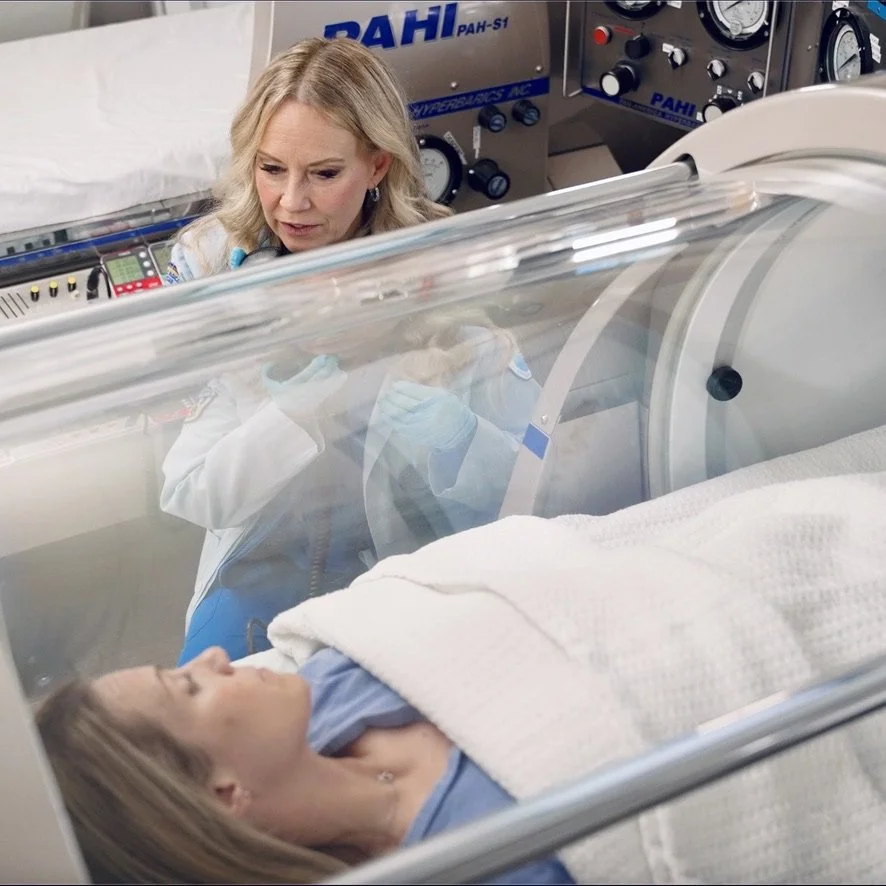
Medical-grade HBOT places a patient inside a hyperbaric chamber while breathing 100% medical-grade oxygen at increased atmospheric pressure.
The pressure painlessly allows considerably more oxygen to dissolve in plasma than would occur while breathing oxygen at normal atmospheric pressure. This can increase oxygen availability to tissues during treatment.
Medical-grade HBOT is different from simply breathing supplemental oxygen. It is also different from lower-pressure soft chambers that use different oxygen-delivery methods and treatment conditions.
For patients considering HBOT, the treatment pressure, oxygen concentration, chamber type, medical supervision, and clinical purpose all matter. Research findings from medical-grade HBOT should not automatically be applied to every type of pressurized chamber. The HBOT chamber must be able to provide certain proven patient protocols as outlined in the research.
What Human Studies Have Found in Older Adults
Human research has begun examining measurable outcomes in healthy older adults.
One randomized controlled trial included 63 healthy adults over age 64 and evaluated cognitive performance after three months of treatment. The researchers reported significant improvements in global cognitive function, with notable changes in attention and information-processing speed. Brain imaging also showed increased cerebral blood flow in several brain regions among participants receiving HBOT.
Another randomized controlled trial studied 63 sedentary adults over age 64 and examined physical performance. After 60 HBOT sessions over 12 weeks, participants receiving HBOT showed improvement in VO₂ max per kilogram compared with the control group. The study also evaluated cardiac perfusion and pulmonary function.
These studies are valuable because they use measurable outcomes rather than relying only on subjective reports. However, relatively small studies cannot establish that HBOT prevents age-related disease or extends lifespan.
Case Study 1: What Does Research Suggest About HBOT and Healthy Aging?
A comprehensive review examined the growing body of research on Hyperbaric Oxygen Therapy (HBOT) and its potential role in healthy aging and age-related conditions. The review considered basic research, preclinical findings, and early clinical studies exploring how controlled exposure to high-concentration oxygen under increased pressure may influence biological processes associated with aging.
Researchers noted that several biological pathways affected by aging overlap with processes influenced by HBOT. These include mechanisms related to tissue oxygenation, vascular function, cellular responses, and other processes involved in maintaining tissue health. The review also highlighted findings from preclinical and small clinical studies that suggest potential benefits across different aspects of aging.
The authors emphasized that these findings represent an emerging area of research rather than proof that HBOT reverses aging or prevents age-related disease. One major need identified by the review is the development of standardized treatment protocols that can be evaluated consistently in larger clinical studies.
The review provides a useful scientific framework for understanding why HBOT is being investigated in aging research while highlighting the need for further clinical evidence before broad anti-aging applications can be established.
For readers interested in the scientific background and deeper research, the following review provides a detailed discussion of HBOT, healthy aging, and emerging age-related applications.
Case Study 2: https://pubmed.ncbi.nlm.nih.gov/34818212/
Case Study 3: https://pubmed.ncbi.nlm.nih.gov/38961397/
Who Should Consider HBOT and Why?
An older adult should not pursue HBOT solely because of age.
The first step is identifying a clear medical or functional reason for treatment and determining whether HBOT has evidence supporting that particular need, indication, condition, or goal. A physician should review the patient's medical history, medications, cardiovascular and pulmonary health, current conditions, and treatment objectives.
The clinical team should also determine whether there are medical factors that could affect treatment suitability.
For some patients, HBOT may be appropriate because of an established medical indication rather than aging itself. For others, participation may be more appropriately limited to a research setting if the proposed use remains investigational.
This distinction protects patients from confusing emerging science with established medical treatment.
In Closing:
Research into HBOT and healthy aging is developing around specific physiological and functional outcomes. Studies have reported changes in cognitive measures, cerebral blood flow, physical capacity, and biological markers in selected older adults. At the same time, the existing research has limitations. Studies may involve relatively small groups, different treatment protocols, and specific populations that do not represent every older adult. Longer-term research is also needed to determine how durable these findings are and whether measurable changes translate into meaningful improvements in everyday health. Healthy aging remains broader than any single therapy. Physical activity, strength training, nutrition, sleep, cardiovascular health, preventive screening, and appropriate management of chronic conditions all contribute to maintaining function. At Advanced Hyperbaric Recovery Inc., patients considering medical-grade Hyperbaric Oxygen Therapy can discuss their individual health goals and medical history with an experienced clinical team. A physician-directed evaluation can help determine whether HBOT has an appropriate role in their care.
For Healthy Aging Month, the most useful way to view HBOT is through the evidence and research.
Frequently Asked Questions:
-
Research suggests HBOT may influence certain biological and functional measures associated with aging, including cerebral blood flow and physical performance. However, it has not been established as a treatment that reverses normal aging.
-
Current evidence does not prove that HBOT reverses biological aging. Early research has identified changes in specific biological markers and functions, but larger and longer clinical studies are needed to determine their lasting health significance.
-
Clinical studies in older adults have reported changes in cognitive performance, cerebral blood flow, and physical capacity following HBOT. These findings are encouraging but apply to specific study populations and treatment protocols.
-
No. Medical-grade Hyperbaric Oxygen Therapy (HBOT) combines increased atmospheric pressure with high-concentration oxygen. This allows substantially more oxygen to dissolve in plasma than breathing supplemental oxygen at normal atmospheric pressure.
-
Older adults should identify a specific health condition or goal that is proven to benefit from HBOT. They need to review their medical history with a physician and ask about evidence, treatment protocols, chamber standards, potential risks, and how progress will be measured.
If you would like more information or to schedule a comprehensive consultation with one of our Hyperbaric physicians, please call 415-785-8652 now.
